What ISO 13485 and CE Actually Cover – and What They Don’t
Ask a supplier whether they hold CE and ISO 13485 and you get two ticks. Ask what those documents cover and the conversation usually stops. Here is the part that matters, written so you can check it yourself.
Almost every buyer in this category asks the same two questions: do you have CE, and do you have ISO 13485? Both are reasonable questions. Neither is the question that decides whether you can legally sell the product in your market.
The documents behind those ticks are not certificates of product approval. They are statements about a factory and about electrical safety, and each one has a defined scope that stops somewhere. Knowing where each scope stops is the difference between a clean import and a shipment held at customs.
At a glance
| Document | Standard or directive | Covers |
|---|---|---|
| ISO 13485:2016 | Medical device QMS GB/T 42061-2022 in China |
The factory: incoming material control, in-process inspection, final inspection, traceability. Not the product. |
| ISO 9001:2015 | Quality management system | The product quality system – process control and record keeping, without the medical-device layer. |
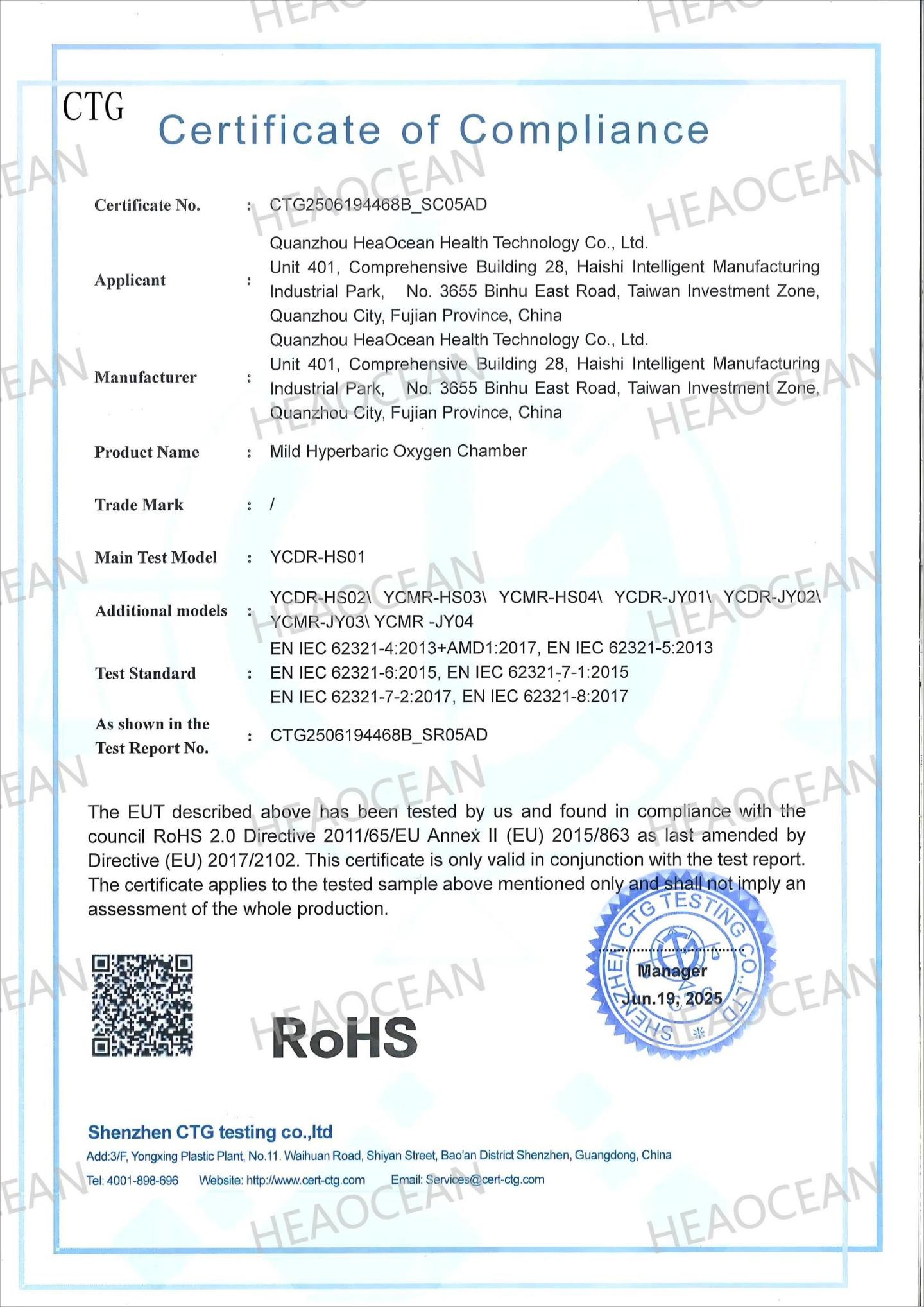
| CE – EMC | Directive 2014/30/EU EN IEC 55014 |
Electromagnetic compatibility: the unit does not interfere with, or get disturbed by, other equipment. |
| CE – LVD | Directive 2014/35/EU EN 60335-1 |
Electrical safety of the equipment: insulation, earthing, thermal and fault behaviour. |
| RoHS | Directive 2011/65/EU IEC 62321 |
Restricted substances in the build – lead, cadmium, mercury, and the rest of the list. |
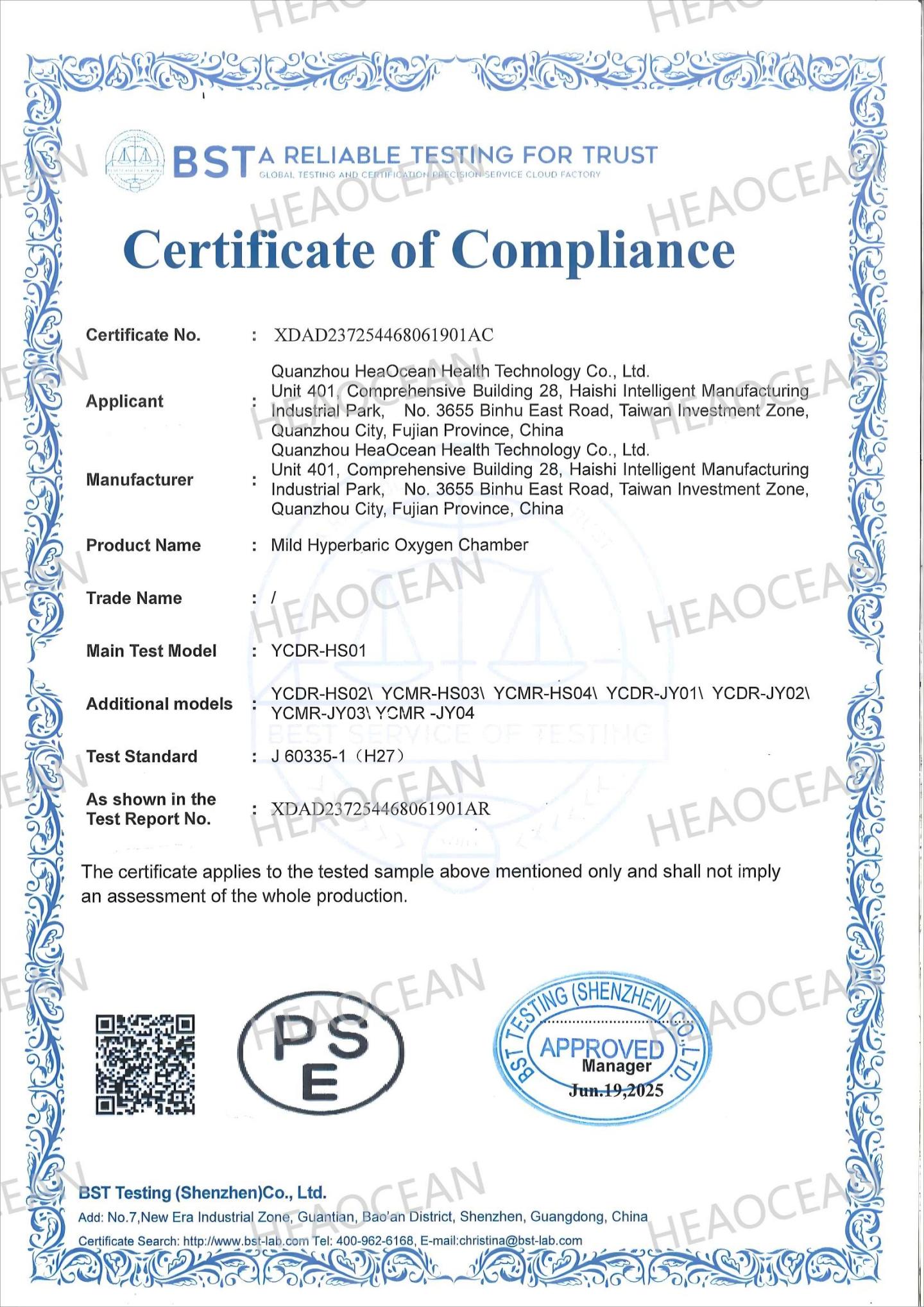
| PSE | J60335-1 | Japan 100 V builds only. A 220 V unit does not carry it, and cannot be made to. |
Read the third column, not the first. Every one of these documents is real and every one of them is useful. None of them says the chamber is a medical device, and none of them says it works.
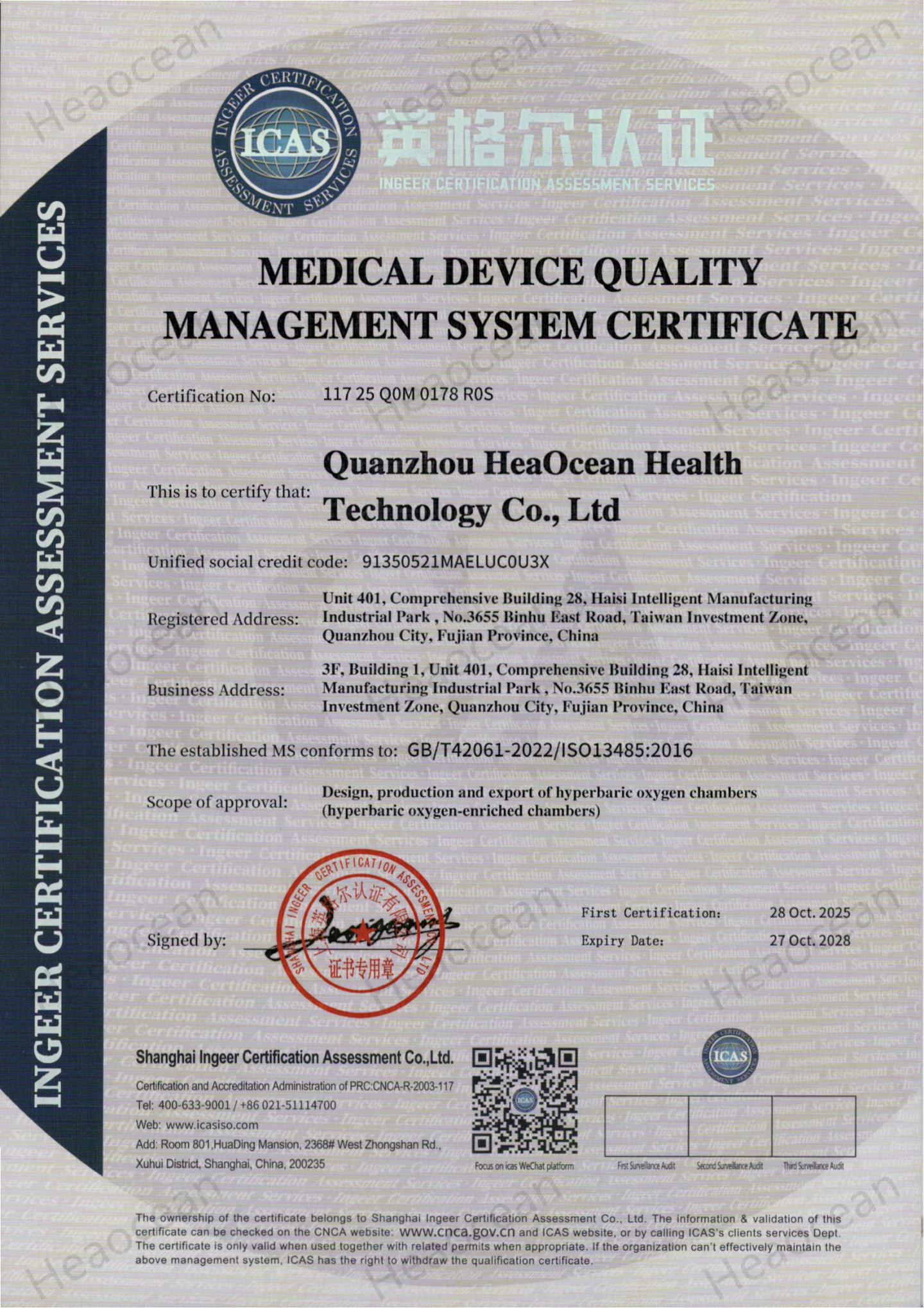
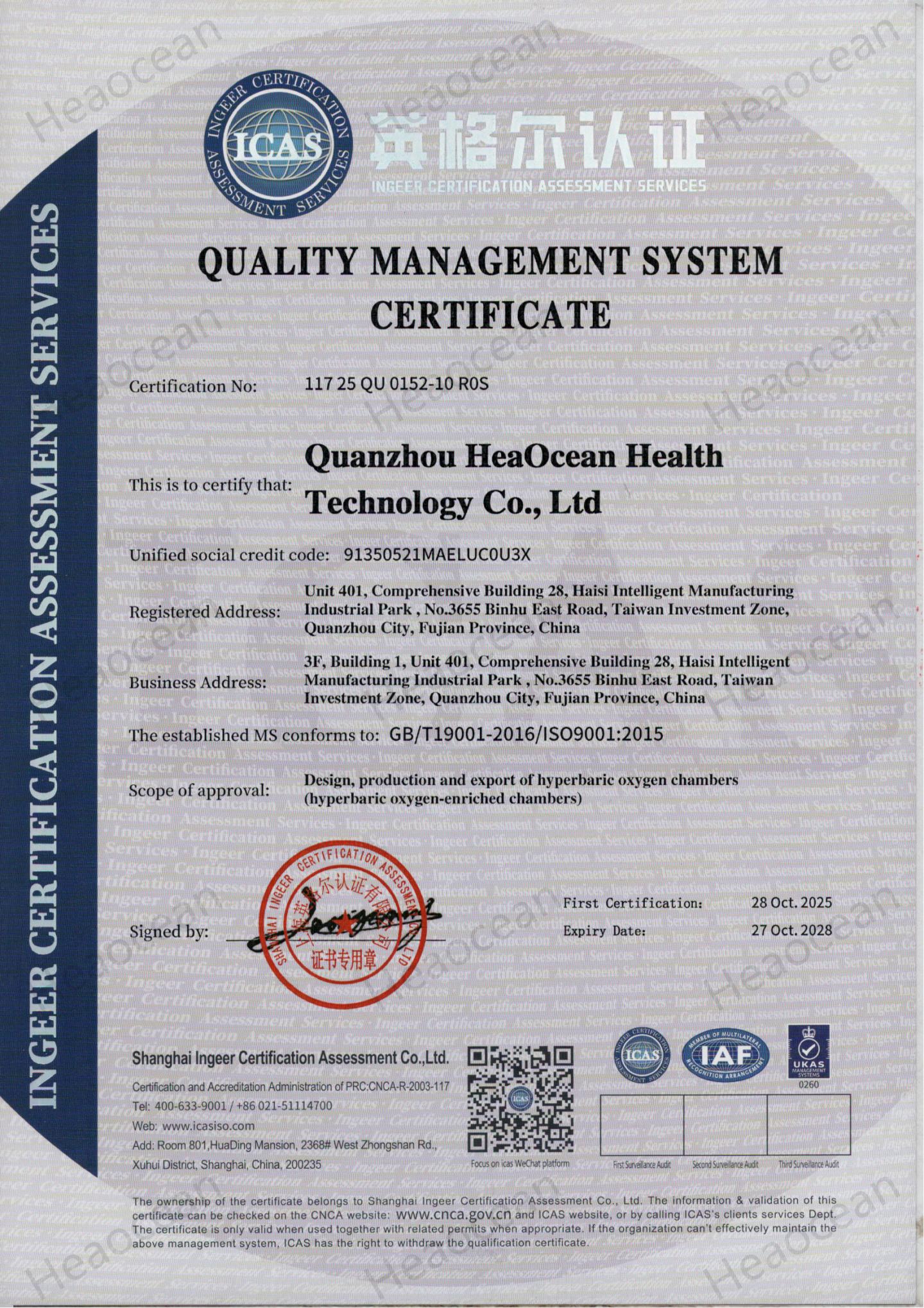
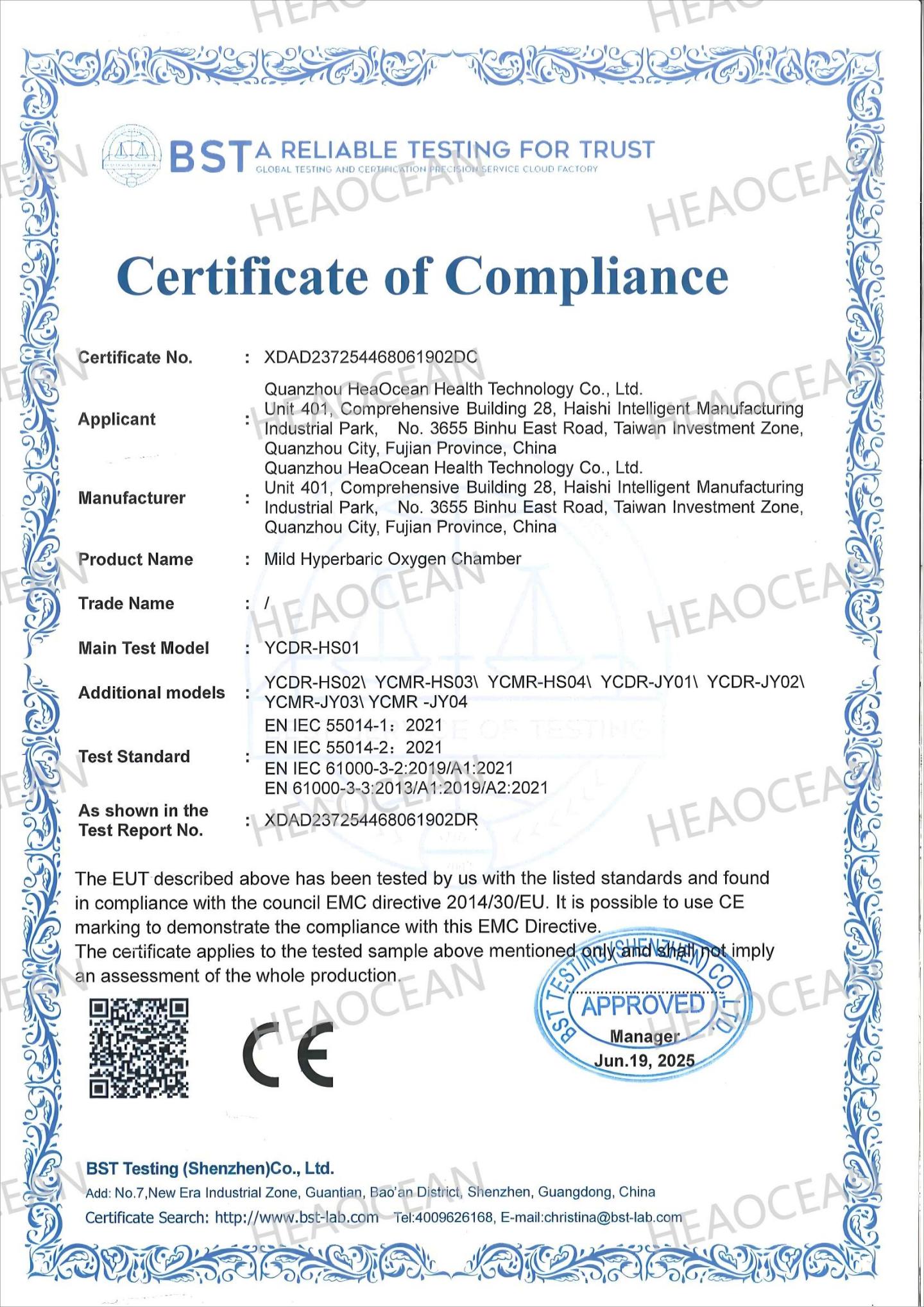
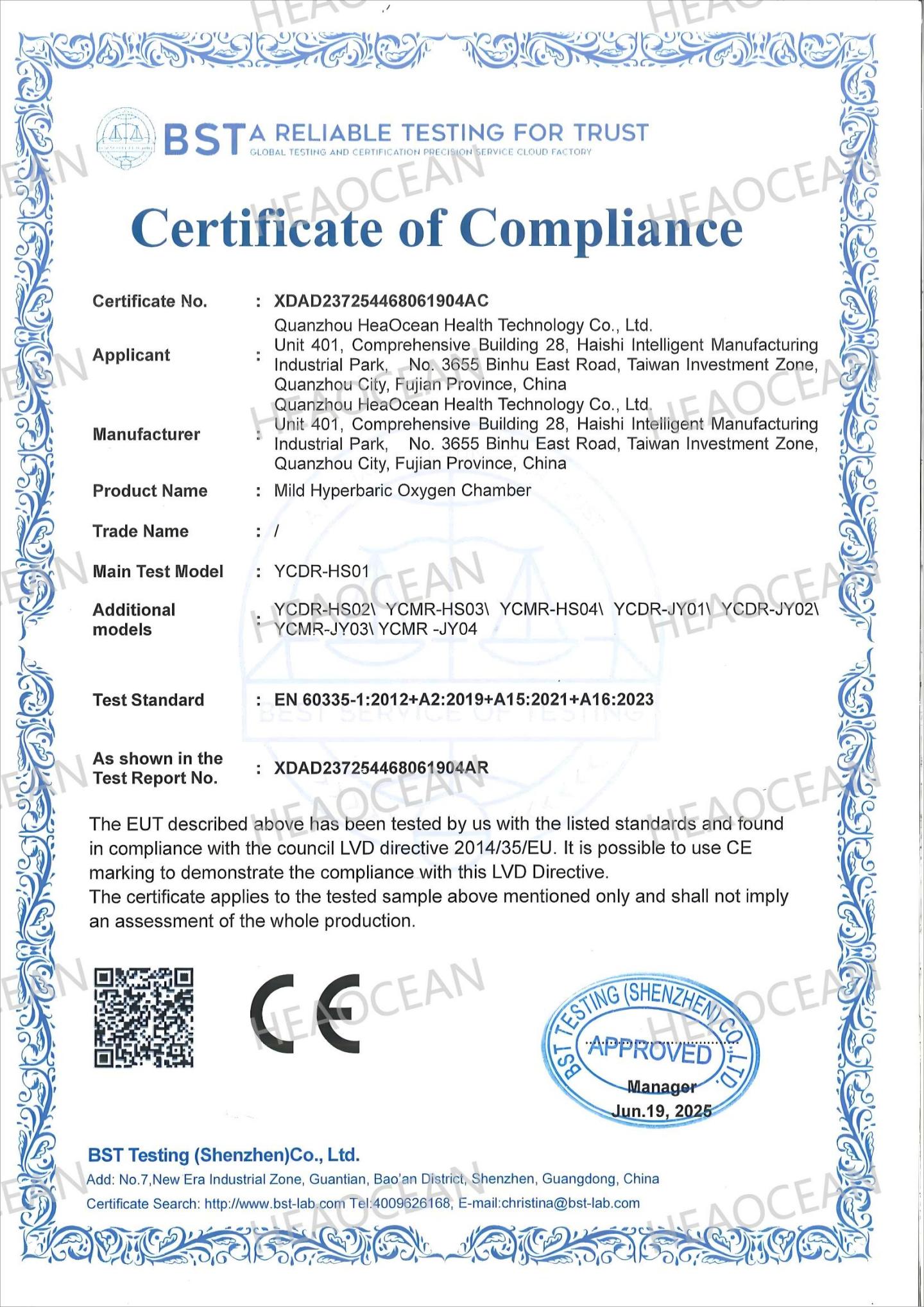
ISO 13485 is about the factory, not the product
This is the single most misunderstood document in the category, and the misunderstanding runs in both directions.
ISO 13485:2016 is a quality management system standard written for medical device manufacturers. When a factory holds it, an auditor has verified that the factory controls what comes in, what happens on the line, and what goes out – and that it can trace a finished unit back to the material batch it was built from. That is a meaningful thing to know about a supplier. It is also entirely separate from whether the product itself is registered as a medical device anywhere.
A certificate card that says ISO 13485 – medical device QMS is easy to read as “this product is a medical device”. It is not what the certificate says, and acting on that reading in your own market is how importers end up making claims they cannot support.
We hold ISO 13485 because we run a controlled factory and our customers audit us against it. We do not claim the chamber is a registered medical device, because in most markets it is not.
What the certificate does buy you, practically, is an audit trail. If a unit fails in the field, a 13485 factory can tell you which material batch went into it, which operator ran the station, and which inspection record it passed. A factory without it usually cannot.
CE is a declaration, not a certificate
This one surprises buyers more often than any other point in this article.
For this product class, no third-party body issues a “CE certificate”. CE marking is the manufacturer’s own declaration that the product meets the applicable directives. We test against the harmonised standards, we compile a technical file, and we sign a Declaration of Conformity – the DoC. That signed document is what CE actually is.
What they are asking for is the DoC. Send the DoC, plus the test reports behind it if they want more. Sending a scanned certificate image instead is the most common reason a listing gets rejected – there is no certificate to send, so what goes out is either the wrong document or a doctored one.
Two consequences follow, and both matter commercially.
First, the DoC names the manufacturer. Certification is issued to us. If your market requires the importer to hold the DoC in their own name, that is a different piece of paperwork and it has to be arranged before we quote, not after the container sails.
Second, rebranding does not transfer it. If you put your logo on the unit and sell it as your product, you may become the entity responsible for the declaration in your market. Ask that question before you order, not after. We will tell you what we can supply and what your side has to handle.
EMC and LVD are two different jobs
Buyers often treat “CE” as one thing. It is at least two here, and they test different failure modes.
EMC (Directive 2014/30/EU, tested to EN IEC 55014) is about interference. A chamber runs an oxygen concentrator and a refrigerated dryer, both with motors and switching electronics. EMC testing asks whether that package disturbs nearby equipment, and whether it keeps working when something nearby disturbs it.
LVD (Directive 2014/35/EU, tested to EN 60335-1) is about electrical safety. Insulation, earthing, temperature rise, behaviour under fault. It is the directive that matters if something goes wrong in a way a customer can touch.
A unit can pass one and fail the other. A supplier who says “we have CE” without saying which directives, and against which standards, has told you very little.
What RoHS and PSE add
RoHS is a materials restriction, not a performance claim. It says the build does not contain the restricted substances above the allowed limits. It matters for customs in the EU and for retail compliance in several other markets, and it is checked by substance testing rather than by inspection.
PSE is the Japanese mark, and it is voltage-specific. A PSE build is a 100 V build. A 220 V unit for Europe cannot be re-labelled into a PSE unit – the electrical package is different. This is the clearest example of why the electrical side, not the shell, drives both lead time and certification cost.
Who actually holds the document
Certification is issued to HEAOCEAN as the manufacturer. That is normal, and it is also where a surprising number of deals get stuck.
| Situation | What changes |
|---|---|
| You import and resell under our brand | Our DoC covers it. You keep a copy on file. |
| You import and resell under your own brand | You may need to issue your own DoC as the entity placing it on the market. Ask us for the technical file contents you will need. |
| Your market requires the importer to hold the DoC | Tell us before we quote. The paperwork changes and it changes the price of the first order. |
| You are selling into a marketplace | They will usually accept the DoC plus test reports. They will usually reject a certificate image. |
What none of this proves
It is worth being blunt about the limits, because a supplier who will not state them is telling you something too.
None of these documents says the chamber is clinically effective. None of them says it will still hold pressure after five years of daily use. None of them says your customers will like it, or that it fits the room you have. Those are separate questions, answered by clinical literature, by cycle testing, and by sitting in one.
What the documents do say is narrower and still valuable: the factory is controlled, the electrics are safe, the materials are restricted-substance compliant, and the unit will not interfere with the equipment next to it.
Why we will not build 2.0 ATA
Buyers occasionally ask us to go above the published range. The answer is no, and the reason is not capability.
Pressure beyond 1.5 ATA requires a different shell construction and, with it, a different certification path. The testing, the technical file, and the standards the unit is assessed against all change. That is a different product with a different compliance story, not an option on this one.
So the published range is 1.3 ATA standard and 1.5 ATA as a custom build. Stating the ceiling is more useful to a buyer than quietly accepting an order we cannot document.
Eight questions to ask any supplier
This list works on us as well as on anyone else. If a supplier cannot answer all eight, the paperwork is thinner than the sales page suggests.
- Which document are you sending me – the certificate, or the Declaration of Conformity? The answer tells you whether they understand their own file.
- Who is it issued to? The manufacturer, or a trading company reselling someone else’s certificate.
- What is the scope – factory or product? A 13485 certificate is almost always the factory.
- Which directives, and which harmonised standards? “CE” alone is not an answer.
- Does the EMC report cover the concentrator and the dryer, or only the chamber? The electrical package is where the compliance risk sits.
- Is there a separate build for Japan, or do you re-certify? PSE is 100 V. There is no shortcut.
- If I rebrand, who issues the DoC in my market? Ask before you order.
- Can I see the test reports, not just the certificate? A supplier who will not share reports has something to hide, or has never read them.
A buyer who understands what the documents cover asks better questions, writes a tighter purchase order, and does not come back six weeks later with a container stuck at a port. That is worth more to us than the short-term advantage of a vague certificate card.
Frequently asked questions
Is a mild hyperbaric chamber a medical device?
In most markets, no – it is sold as a wellness or recovery product. Some markets classify higher-pressure chambers as medical devices. That classification depends on pressure, on claims, and on the destination country, not on the certificate the factory holds. We cover the positioning question in a separate article.
Does ISO 13485 mean the product is certified?
No. It certifies the quality management system of the factory. It is evidence that the manufacturing process is controlled and traceable. It is not a product certification and it is not a market authorisation.
Can you send me a CE certificate?
There is no third-party CE certificate for this product class. What exists is the Declaration of Conformity, signed by us as the manufacturer, plus the test reports behind it. We send both.
My marketplace rejected the certificate image. What do they want?
Almost certainly the DoC. Marketplaces and customs authorities ask for the declaration and, sometimes, the underlying test reports. A certificate image is neither.
Do you have FDA clearance?
No, and we do not claim it. FDA clearance applies to medical devices. If your business model requires that classification in the United States, this product is not the right starting point and we would rather say so now.
What if I put my own brand on the unit?
Your obligations may change. In several markets the entity placing the product on the market carries the declaration responsibility. We will supply the technical file contents you need, but the declaration in your market is yours to issue. Raise it before ordering.
Does the certificate cover the concentrator and the dryer?
The electrical safety and EMC assessment covers the electrical package as supplied with the unit. If you source your own concentrator locally, that component falls outside our declaration and you will need its own documentation.
Why is there no 2.0 ATA option?
Above 1.5 ATA the shell construction and the certification path both change. It is a different product, not an option. We would rather state the ceiling than take an order we cannot document.
Can I see the certificates and test reports before ordering?
Yes. Ask for the compliance pack with your quotation and it comes with the full table, the scans, and the report references. We do not send them as a sales attachment before there is a real requirement, because half of them are irrelevant to any given market.
HS050
HC050
HL050
Ask for the compliance pack with your quotation
Tell us the destination market and how you intend to sell – under our brand, under yours, or through a marketplace. We will send the documents that apply to that route, not a folder of everything.
This article describes the documentation HEAOCEAN holds and how it is structured. It is not legal advice, and market requirements differ by country. Confirm the requirements of your own market with a regulatory professional before importing. HEAOCEAN manufactures mild hyperbaric chambers for wellness and recovery use; our products are not registered medical devices in most markets and we make no medical claims for them.