Chamber Basics
What Is a Mild Hyperbaric Chamber (mHBOT)?
A mild hyperbaric chamber is a soft-sided, zippered enclosure that raises the air pressure around one seated or lying person to about 1.3 ATA — roughly 30% above pressure at sea level — while an oxygen concentrator feeds oxygen-enriched air into the space. It is supplied as a wellness product, not a medical device. This guide covers what the equipment actually does, what ships in the cartons, how a session runs, how it differs from clinical HBOT, and what to confirm before you specify one.
At a glance
What "mild" actually means
Pressure is measured in ATA — atmospheres absolute. Sea level is 1.0 ATA. Every chamber described as "hyperbaric" sits above that number, but the range is wide, and the word alone tells you very little about the equipment or what it is for.
| Pressure | What it describes | Typical equipment |
|---|---|---|
| 1.0 ATA | Normal ambient pressure at sea level | Not a chamber |
| 1.3 ATA | HEAOCEAN standard specification for soft-shell models | Soft-sided, zippered, portable |
| 1.5 ATA | Custom configuration, confirmed at quotation stage | Soft-sided, built to order |
| 2.0–3.0 ATA | Clinical hyperbaric oxygen therapy, delivered under medical supervision | Rigid acrylic or steel chamber, hospital setting |
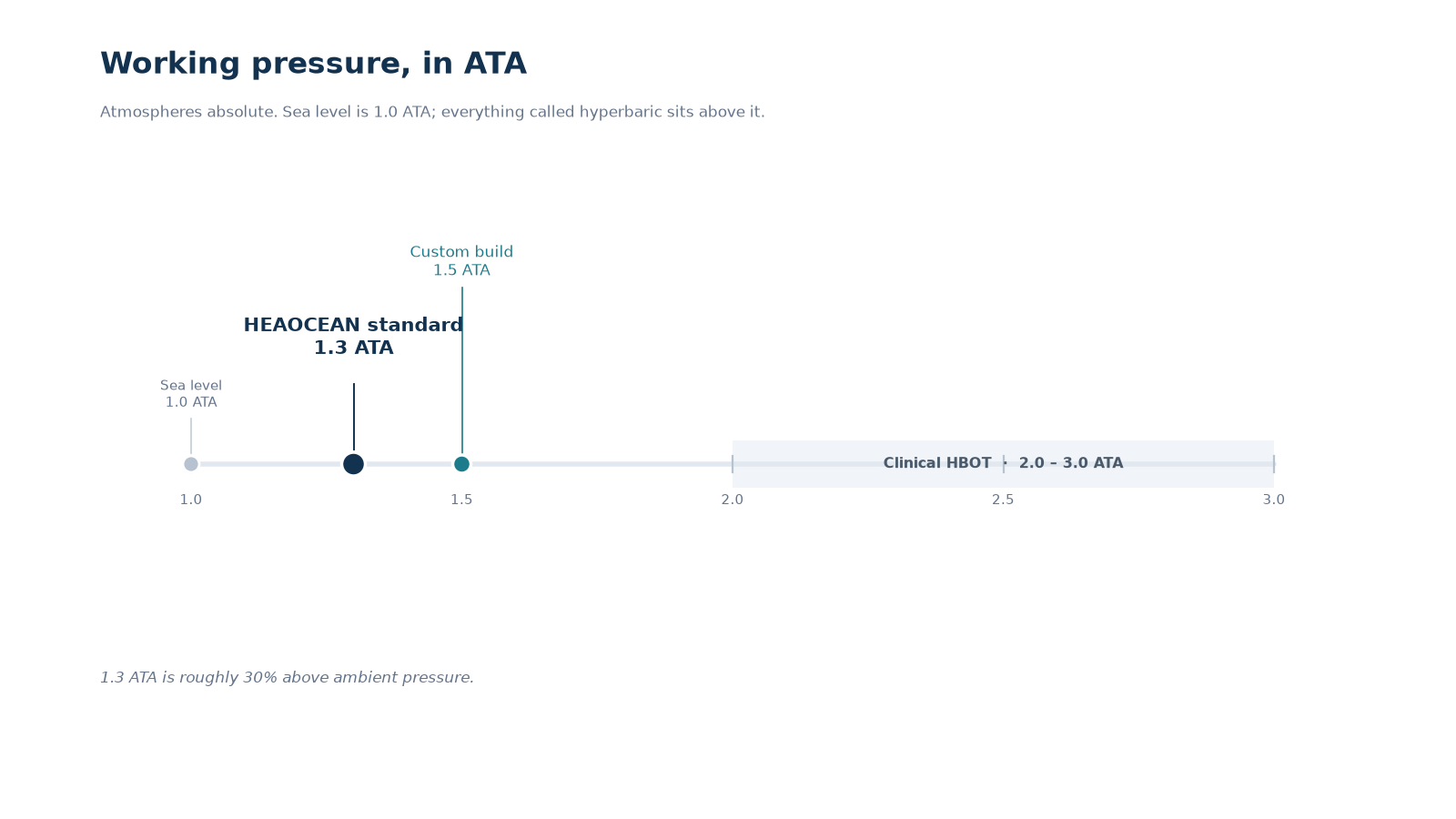
"Mild" in this context means the chamber operates close to normal atmospheric pressure — not that the equipment is a lighter version of a hospital device. A mild chamber and a clinical chamber are different categories of product with different pressure ranges, different oxygen delivery, and different regulatory treatment. We cover that split in more detail under What a mild chamber is not.
What ships with the chamber
A chamber is not one item. What arrives in the cartons determines whether the unit can run on day one, and it is the first thing to check on a packing list before you compare prices.
| Item | What it does |
|---|---|
| Soft chamber shell | The pressurized envelope, with entry zipper, viewing window, and pressure-relief valve |
| Internal frame | Metal arcs that hold the shell open; they are structure, not part of the zipper |
| Oxygen concentrator | Separates oxygen from room air and feeds it into the chamber; rated 5 L/min at 93% ± 3% output on soft-shell models |
| Air cooler / dryer | Manages temperature and humidity inside the shell during a session |
| Mask or hood and tubing | Delivers the enriched air to the occupant |
| Pressure gauge and control valve | Shows internal pressure and sets the working level |
| Repair kit | Patch material for minor shell damage |
| Manual and warranty card | Model-specific operating limits, cleaning schedule, and claim terms |
How a session runs
A session is a sequence, not a switch. The pattern is the same across soft-shell formats, and the timings below are typical rather than fixed — the manual for your model governs.
- Enter and seal. The occupant sits or lies inside, the entry zipper is closed, and the relief valve is checked.
- Pressurize gradually. Pressure is raised to the working level over a few minutes. Mild ear pressure is the usual sensation, similar to a descent in an aircraft; swallowing or yawning clears it.
- Hold. The concentrator runs through the session, typically 60 minutes. Most operators leave the occupant resting quietly with a phone or book outside the shell.
- Depressurize slowly. Pressure returns to ambient over several minutes. Rushing this step is the most common cause of discomfort.
- Air and clean. The shell is opened, allowed to dry, and wiped down before the next user.
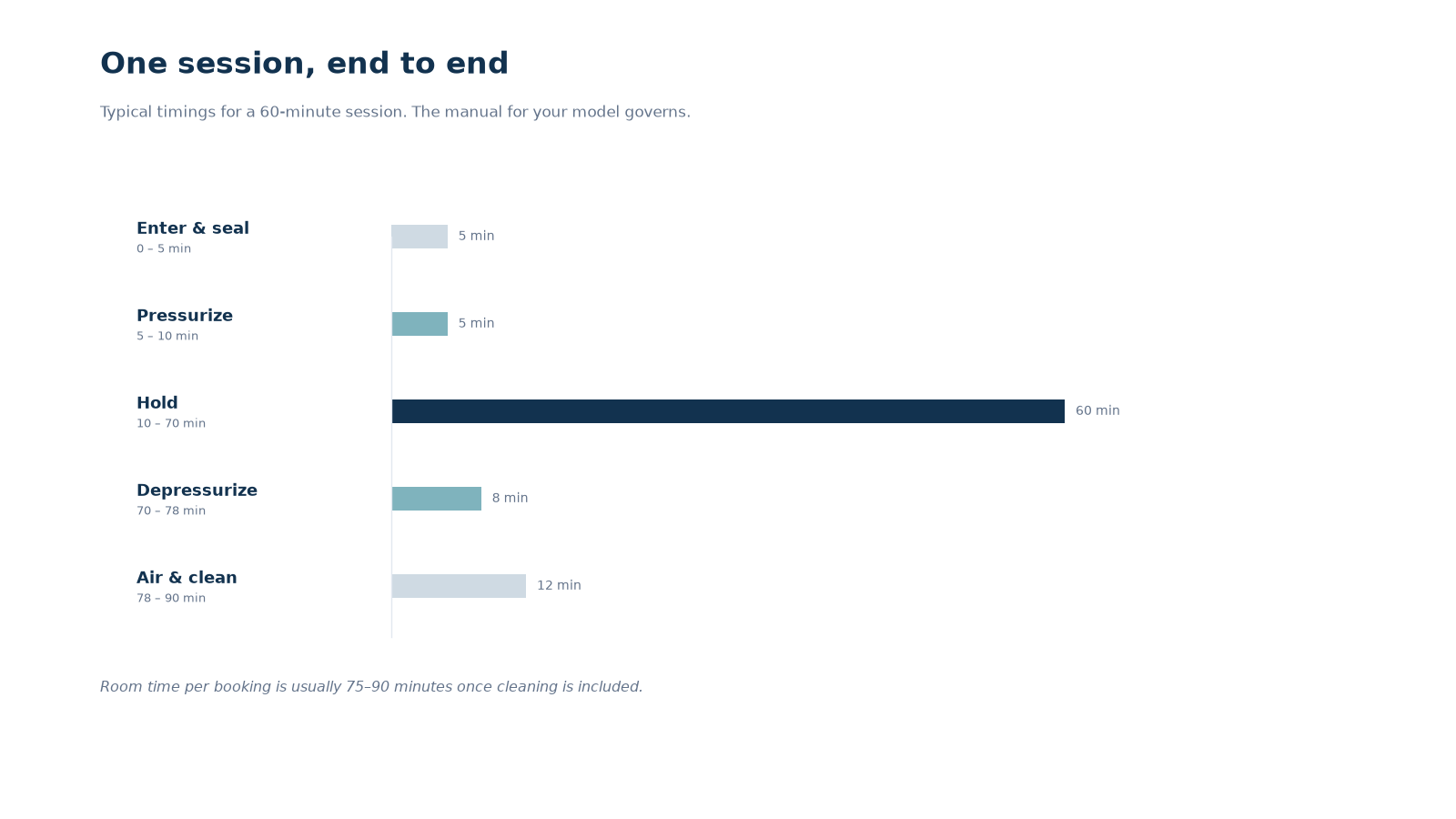
Total wall-clock time per session, including entry, pressurization, and cleaning, is usually 75–90 minutes. That figure — not the 60-minute session — is what determines how many bookings a room can take in a day.
What a mild chamber is not
The two categories are often described with the same vocabulary online, which causes most of the confusion buyers bring to us. They are not interchangeable, and the difference is not a matter of degree.
| Feature | Mild hyperbaric chamber (HEAOCEAN) | Clinical HBOT |
|---|---|---|
| Pressure | 1.3 ATA standard; 1.5 ATA custom build | 2.0–3.0 ATA |
| Oxygen supply | Oxygen-enriched air from a concentrator | Near-100% medical-grade oxygen |
| Structure | Soft-sided, zippered, portable | Rigid chamber, fixed installation |
| Setting | Home, studio, spa, gym, hotel | Hospital or licensed clinic |
| Oversight | Operator follows the manual; no clinical supervision claimed | Physician-supervised |
| Regulatory status | Supplied as a wellness product, not a medical device | Regulated medical device in most markets |
| Intended use | General relaxation and personal wellness routines | Specific cleared medical indications |
| Evidence base | Limited for health claims below 2.0 ATA | Substantial for its cleared indications |
Who uses one, and where
Mild chambers are bought by two very different groups: operators who run them as a service, and brands that resell them. The format tends to follow the room, not the other way around.
| Setting | Typical format | What drives the choice |
|---|---|---|
| Home wellness room | Lying or sitting | Room length, noise, and whether one person uses it or two |
| Gym and recovery studio | Sitting & lying | Turnover between bookings, cleaning time, floor space |
| Spa and salon | Sitting | Appearance, quiet operation, fitting an existing treatment room |
| Hotel and resort | Sitting or sitting & lying | Guest flow, staff training, service wording |
| Distributor or brand | Mixed range | Model mix, documentation, customization, spare-parts plan |
Why people start looking: the tiredness question
One of the most common reasons people search for a chamber is simpler than the marketing suggests: they feel tired, they have already tried sleep hygiene, and they are looking for something to add to a routine. That is a wellness question, not a diagnosis, and it is worth keeping the two separate. We cover that question in its own guide: Feeling constantly tired? What's actually going on.
Persistent tiredness has many ordinary causes — sleep debt, schedule, workload, iron status, thyroid function, medication, mood. None of these can be assessed by a chamber, and none of them should be self-managed with equipment. If tiredness is new, persistent, or affecting daily function, the useful first step is a conversation with a qualified healthcare professional.
Where a chamber fits is narrower and more honest: some people treat a session the way others treat a sauna or a massage — a scheduled, low-stimulation block in the week that they do not spend on a screen. That is a routine decision, not a therapeutic one. We describe it that way because overstating it would be both inaccurate and, in most markets, non-compliant.
What to confirm before you order
Most specification mistakes happen before the quotation, not after delivery. Four things are worth settling in writing.
1. Floor space
Chamber size is not the number to plan with. You need the planning zone, which includes the equipment bay, a heat-dissipation gap, and an access walkway.
| Model | Posture | Chamber size | Planning zone |
|---|---|---|---|
| HS050 | Seated | 1600 × 650 × 1200 mm | 2.47 m² |
| HC050 | Seated or lying | 2000 × 650 × 1200 mm | 2.87 m² |
| HL050 (M) | Full-length lying | Ø 750 × L 2000 mm | 3.16 m² |
| HL050 (L) | Full-length lying | Ø 800 × L 2250 mm | 3.59 m² |
2. Access route
Door width, stair turns, and lift dimensions decide whether a unit can reach the room at all. Check the route before the room.
3. Electrical supply
The chamber and the concentrator may use separate connections. Give the supplier your destination, voltage, frequency, and plug type so the package matches what will actually be installed.
4. Documents
Ask for the model-specific specification sheet, manual, packing list, and the certification documents that apply to your destination. Certification scope varies by model and market, and it should be confirmed for the exact unit you are buying.
Two certifications are often quoted together, and they mean different things. ISO 9001 applies to the product. ISO 13485:2016 applies to the factory's quality management system — it is the standard a site is audited against to manufacture medical devices, which is why a factory holds it. It does not change what the product is: HEAOCEAN chambers are health and wellness products, not medical devices.
Frequently Asked Questions
What pressure does a mild hyperbaric chamber use?
HEAOCEAN standard soft-shell models operate at about 1.3 ATA. A 1.5 ATA configuration is available as a custom build and is confirmed in writing before production. Clinical hyperbaric oxygen therapy typically operates at 2.0–3.0 ATA.
Is a mild hyperbaric chamber a medical device?
No. HEAOCEAN chambers are supplied as wellness products for general relaxation and personal wellness use. They are not intended to diagnose, treat, cure, or prevent any disease. Requirements for operating or advertising them vary by country, so confirm the rules for your destination.
Does it use pure oxygen?
No. It uses room air enriched by an oxygen concentrator, not near-100% medical-grade oxygen. The concentrator on soft-shell models is rated 5 L/min at 93% ± 3% output, which is the supply concentration rather than the level inside the chamber.
How long is a session?
Session duration is set by the manual supplied with your specific model. Many operators schedule 60 minutes inside the chamber, with pressurization, depressurization, and cleaning bringing total room time to roughly 75–90 minutes. Do not set duration from a general article or another model's instructions.
Can one person install it?
Assembly is a two-person job in practice for the larger formats, mainly because of the frame and shell. Allow 40–60 minutes for a first installation, and plan the access route in advance.
Can I switch a 1.3 ATA unit to 1.5 ATA later?
Do not assume 1.5 ATA is a selectable setting on a standard unit. It is a separate custom-order requirement confirmed before production. Operate each chamber only within its documented limits and do not modify pressure-control or safety components.
What do the ISO certifications cover?
Two different things, and the distinction matters. The chambers are certified to ISO 9001, the general quality management standard. The factory's quality management system is certified to ISO 13485:2016, the standard used for medical device manufacturing — which means the site is equipped and audited to build medical devices, not that the product is one. HEAOCEAN chambers are health and wellness products, not medical devices.
Where can a mild chamber be installed?
Any room that meets the planning zone, access route, and electrical requirements, with adequate ventilation. Confirm floor loading and local installation rules for the specific site rather than relying on a general recommendation.
Choosing a mild hyperbaric chamber
HEAOCEAN supplies four soft-shell formats and a two-seat hard-shell model. The format decision usually comes down to posture, room length, and how many bookings the room needs to take.
Sitting HS050
1600 × 650 × 1200 mm. Smallest planning zone at 2.47 m².
Sitting & Lying HC050
2000 × 650 × 1200 mm. Seated or lying in one chamber.
Lying HL050
Ø 750 × L 2000 mm (M) or Ø 800 × L 2250 mm (L). Full-length lying.