Chamber Basics
Soft Shell vs Hard Shell Hyperbaric Chamber
The structure decision drives almost everything else a buyer cares about: the pressure ceiling, the leak rate you have to live with, the freight bill, the installation effort, and how easily a unit can be serviced after the sale. This guide compares the two on the numbers that can be checked — pressure limits, leakage, seam construction, oxygen delivery, safety redundancy, and service life — and then shows where the two routes diverge on landed cost. HEAOCEAN standard soft-shell chambers run at 1.3 ATA, with 1.5 ATA available as a custom build.
At a glance
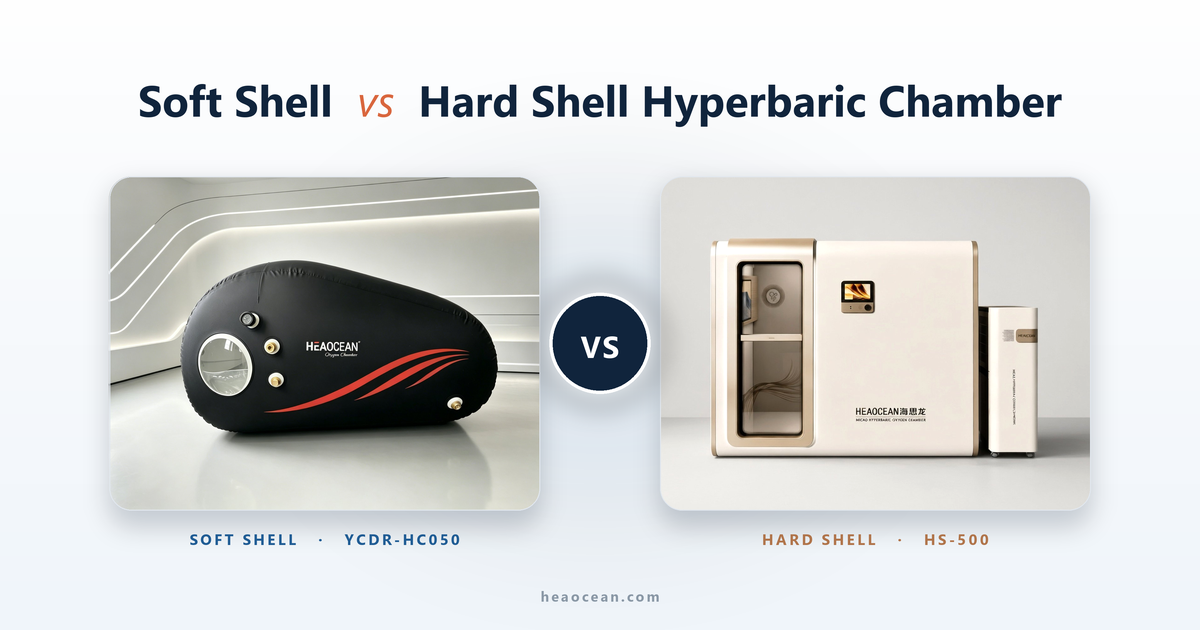
Two structures, two design logics
A hard shell carries pressure in a rigid wall. A soft shell carries it in a flexible membrane that expands as it pressurizes. That single difference propagates into materials, weight, installation, and price.
| Aspect | Hard shell | Soft shell |
|---|---|---|
| Shell material | Carbon steel, stainless steel, aviation aluminium, carbon fibre, thick PC or acrylic | TPU (polyether polyurethane) composite fabric, or PVC-coated cloth on low-cost units |
| How it holds pressure | Rigid wall; the shell does not deform when pressurized | Membrane; the shell expands and the side walls draw in slightly under pressure |
| Window and door | Large acrylic viewport, mechanical locking door | Transparent viewing panel, multi-layer zipper entry |
| Weight and handling | Several hundred kilograms to almost two tonnes; professional installation, sometimes a door removed to get it in | Tens of kilograms; folds for storage, can be relocated by two people |
| Space experience | Fixed internal volume; multi-person formats are common | Usable height shrinks slightly when pressurized because the top expands |
| Entry cost | High; a single-person clinical unit is a capital purchase | Low relative to a rigid unit; entry-level models sit an order of magnitude below |
The material point deserves its own paragraph, because it is the single largest driver of soft-shell cost and the one buyers most often miss. TPU versus PVC is not a marketing distinction. TPU needs no plasticiser, has almost no odour, does not stiffen in cold weather, and resists tearing and pressure cycling far better; a well-built TPU shell is expected to last three to five years or more. PVC is cheaper, goes brittle in winter and soft in summer, ages and leaks earlier, and carries a noticeable smell. Most sub-thousand-dollar units on marketplaces are PVC or very thin TPU.
What the standard actually caps
China's light-industry standard for household mild oxygen chambers, QB/T 8049-2024, took effect in June 2025 and is the first standardised reference point for this category. It is the manufacturing-country standard: it is not a US or EU requirement, and holding to it does not make a product a medical device. But it is useful, because it puts hard numbers on limits that marketing pages tend to blur.
| Requirement | Limit | What it means in practice |
|---|---|---|
| Hard-shell working pressure | Not more than 0.05 MPa (about 1.5 ATA) | Rigid units sold under this standard sit in the same pressure band as soft shells |
| Soft-shell working pressure | Not more than 0.04 MPa (about 1.4 ATA) | Sets the ceiling for any soft chamber sold as a household appliance |
| Design pressure, both types | Below 0.1 MPa | The vessel is designed for a pressure it is never run at |
| Overpressure response | Automatic stop or relief at 10% above rated pressure | A physical and control-level backstop, not a user judgement call |
| Pressurisation rate | 0.002–0.02 MPa per minute | Too fast is the main cause of ear discomfort; the rate is part of the specification |
| Leak rate, hard shell | Not more than 2.0% per minute | Rigid seals hold pressure predictably |
| Leak rate, soft shell | Not more than 5.0% per minute | 2.5× the hard-shell allowance — the number that matters most below |
| Emergency depressurisation | Single-person: to 0.01 MPa within 1.0 min. Multi-person: within 2.5 min | Sets the exit time in an emergency |
| Noise | External not more than 65 dB(A); internal not more than 60 dB(A) | Determines whether a session is restful or merely tolerable |
Leak rate: the number that separates good from cheap
The standard allows a soft shell to lose up to 5% of its pressure per minute, against 2% for a hard shell. That allowance is generous, and the difference between a unit that sits near the limit and one that holds well is where most of the user experience lives.
A leaky shell sets off a chain: the compressor restarts constantly to top up → noise rises and power draw climbs → pressure oscillates in a sawtooth instead of holding steady → the sieve bed runs at high load and ages faster → the occupant feels more ear pressure, not less. Most of the complaint that a soft chamber "feels cheap next to a hard one" traces back to seam quality rather than to the fact that it is soft.
That is why the seam is the first thing worth inspecting on a soft unit.
Seams: welded or glued
| Construction | How it is made | What it means over time |
|---|---|---|
| High-frequency welded | TPU is fused to itself in a high-frequency electric field; joint strength approaches that of the parent material | Holds pressure, no adhesive to outgas, no glue line to fail first |
| Glued / taped | Panels joined with adhesive or seam tape | The adhesive is both an odour source and the earliest point of ageing; leaks usually start at a seam |
HEAOCEAN builds the whole shell with high-frequency welding and no adhesive anywhere in the chamber body. The practical consequences are a lower leak rate from the outset and the removal of the solvent smell that cheap soft chambers are known for. The entry is a double zipper, inside and out, which gives two independent sealing barriers at the weakest point of any soft design.
If you are comparing two soft chambers and the price gap seems inexplicable, this is usually the explanation. Ask one question — welded or glued — and the answer tells you more than any brochure.
The oxygen system: four things worth comparing
Buyers tend to compare pressure because it is a single number. The oxygen side matters more, and it has four checkable parts.
| What to compare | Why it matters | What to ask for |
|---|---|---|
| Oxygen source purity | Determines what is actually being delivered into the shell | Medical-grade sieve bed; output concentration stated on the specification sheet |
| Delivery stability | A concentrator that surges produces uneven sessions | Rated flow (L/min) at rated concentration, not a peak figure |
| Pressurisation and oxygen in step | If the two run separately there is a dead window where pressure has arrived and oxygen has not | Confirmation that the two circuits start together |
| Monitoring | Pressure and concentration should be visible, not inferred | Live pressure display, and an alarm if concentration drifts |
HEAOCEAN soft-shell sets use a medical-grade molecular sieve concentrator rated 5 L/min at 93% ± 3% output, with the pressurisation and oxygen circuits started together, an oil-free compressor, and a live pressure display.
Air quality inside the shell
A soft chamber usually cannot take an air conditioner, so it relies on circulating treated air. That is where the daily experience is won or lost: stuffiness, humidity, smell, and condensation are the standard complaints, and none of them are solved by fitting a bigger fan.
The pressurised air comes from a compressor. If that air is not filtered for oil and micro-organisms, whatever is in the compressor and the pipework is delivered into a sealed space someone is sitting in. HEAOCEAN runs the intake air through a nine-stage filtration train — coarse and fine particulate, odour, oil, and microbial stages — and adds a negative-ion circulation system inside the shell to keep air moving and reduce the closed-in feel.
This matters commercially more than it sounds. The most expensive failure in this category is not buying the wrong model; it is buying a unit nobody wants to sit in for an hour a day.
Safety redundancy: what to see on the unit
Two claims circulate and both are wrong: that a soft chamber is unsafe because it is soft, and that it is inherently safe because the pressure is low. The energy is lower, but the risk moves from the structure to the material, the seams, and the relief path. That is why redundancy, not pressure, is the thing to inspect.
| Requirement | What it looks like on a compliant unit |
|---|---|
| At least two protection devices | Mechanical relief valve plus a control-level cut-out, not one or the other |
| Automatic relief at 10% over pressure | Physical relief that works with the electronics off |
| Dual relief path | Two independent routes out, so a single blockage is not a single point of failure |
| Anti-pinch entry and door interlock | The unit cannot be pressurised with the entry open |
| Live pressure and concentration display with alarm | Readable from inside as well as outside |
| Emergency depressurisation time | Single-person to 0.01 MPa within 1.0 min |
| Double zipper, operable from both sides | An exit that does not depend on someone outside |
| Noise inside the shell | 60 dB(A) or lower, so a session can be restful |
HEAOCEAN's configuration maps to that list item by item: multiple relief valves that act mechanically rather than through the controller, a live pressure readout, the inside-and-outside double zipper, a shaped transparent viewing panel, and an oil-free compressor with noise treatment.
Service life and cost of ownership
Purchase price is the least interesting number in this comparison. What a buyer actually owns is a lifespan and a maintenance obligation.
| Category | Typical service life | Main maintenance | Resale value |
|---|---|---|---|
| Soft shell, PVC or thin TPU, glued seams | About 1–2 years | Once it leaks, the shell is usually replaced whole | Very low |
| Soft shell, quality TPU, welded seams | About 3–5 years and beyond | Cleaning, zipper inspection, seam inspection | Low to moderate |
| Hard shell, steel or stainless | 8–10 years and beyond | Corrosion protection, seal replacement, periodic inspection | Moderate |
| Hard shell, carbon fibre or aluminium | Around 15 years | Light weight, corrosion resistant | Relatively high |
The honest conclusion is not that one column wins. A hard shell suits a fixed space — a large flat, a villa, a clinic or a store — where the unit will run for five years or more, several people will use it, and the budget and installation conditions are available. Its advantages are interior volume, temperature control, acoustic isolation, and service life.
A soft shell suits rented and small homes, gyms and studios that may relocate, mobile and event use, and buyers who want a low entry point. Its advantages are footprint, storability, handling, and initial cost. Every soft-shell weakness has a corresponding fix — welding for sealing, staged filtration and ion circulation for air feel, a medical sieve bed for oxygen, an oil-free compressor for noise, and dual relief plus a double zipper for safety. The question is whether the unit you are quoting actually has those, or only claims them.
Cross-border shipping: where structure changes landed cost
A hard shell is a large rigid object, so a buyer chooses between two expensive routes: ship assembled as oversized freight, where volume drives the bill, or stock units in an overseas warehouse and pay local specialists to install them, which adds warehousing and labour.
A soft shell set ships as a small number of cartons. The figures below come from HEAOCEAN packing sheets for standard soft-shell sets and include the chamber cover, oxygen concentrator, refrigerated air dryer, and internal frame, plus base plate and chair where applicable.
| Configuration | Cartons | Net / gross weight | Carton volume |
|---|---|---|---|
| Sitting HS050 | 6 | 66.7 / 74.8 kg | 0.51 m³ |
| Sitting & Lying HC050 | 5 | 62.2 / 68.1 kg | 0.34 m³ |
| Sitting & Lying HC050, with optional chairs | 7 | 81.5 / 92.1 kg | 0.77 m³ |
| Lying HL050 | 4 | 50.4 / 55.2 kg | 0.52 m³ |
Final packing, weights, and accessories are confirmed in the written quotation. Hard-shell packing data is provided separately on request.
Inflatable-frame prototype
HEAOCEAN has built a prototype in which the metal internal frame is replaced by an inflatable frame; the cover, oxygen concentrator, and air dryer are unchanged.
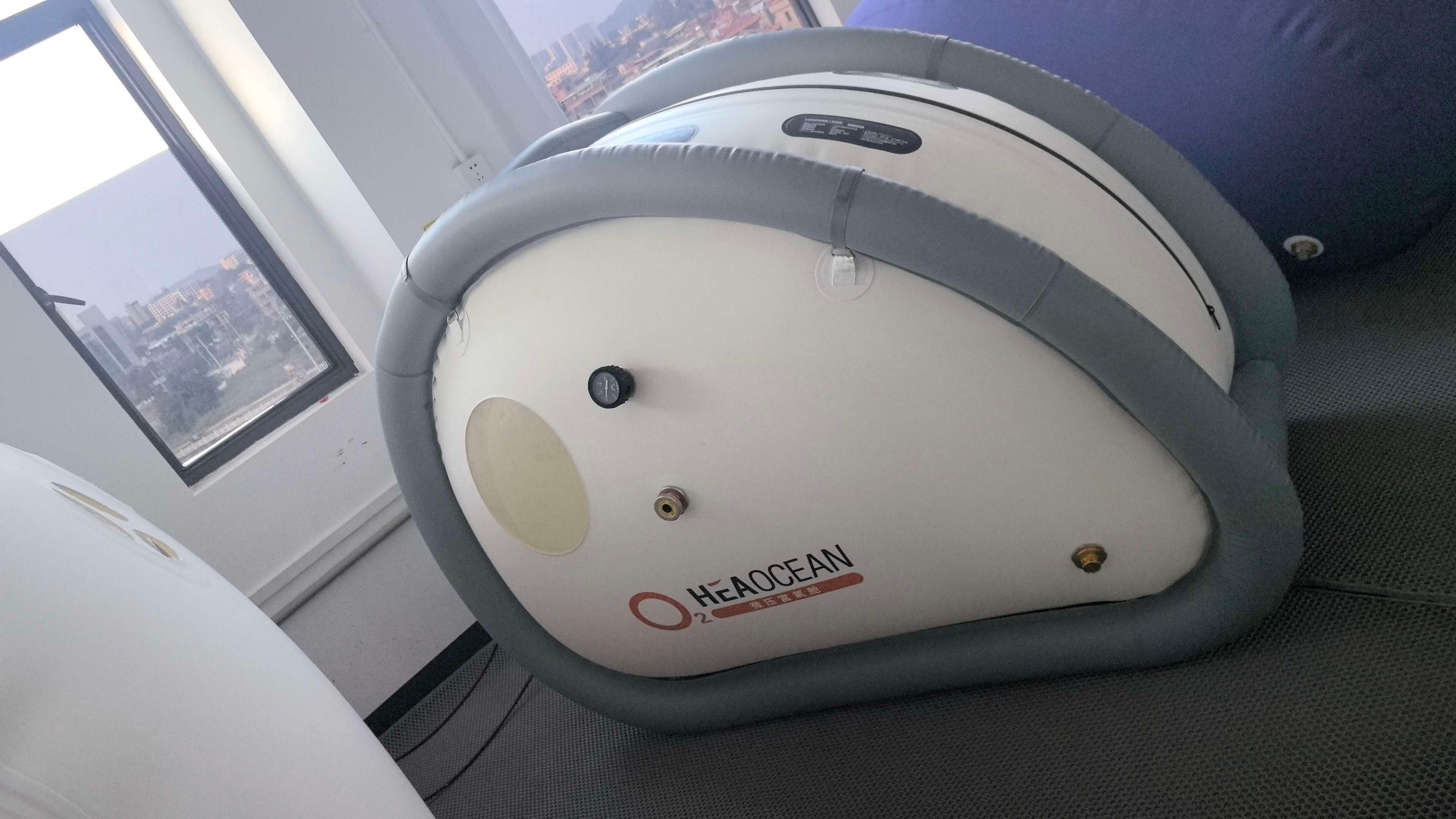
| Item | Standard soft shell (metal frame) | Inflatable-frame prototype |
|---|---|---|
| Frame | Metal internal frame | Inflatable frame |
| Frame volume and weight | Per packing sheet | Estimated about one half to two thirds lower (not measured) |
| Cover, concentrator, dryer | As supplied | Unchanged |
| Whole-shipment data | See table above | To be published after prototype packing and weighing |
This is an internal estimate at prototype stage, not a measured result. Because only the frame changes, the whole shipment will shrink by less than the frame does.
Installation and room planning
Soft-shell setup is lighter, but the room still has to be right. Reference planning zones run from 2.47 m² (26.6 sq ft) for the Sitting HS050 to 3.59 m² (38.6 sq ft) for the Lying HL050 (L). The zone includes the chamber, the equipment bay, a 100 mm heat-dissipation gap, and an access walkway.
| Model | Chamber size | Planning zone (L × W) | Planning zone area |
|---|---|---|---|
| Sitting HS050 | 1600 × 650 × 1200 mm | 2470 × 1000 mm | 2.47 m² / 26.6 sq ft |
| Sitting & Lying HC050 | 2000 × 650 × 1200 mm | 2870 × 1000 mm | 2.87 m² / 30.9 sq ft |
| Lying HL050 (M) | Ø 750 × L 2000 mm | 2870 × 1100 mm | 3.16 m² / 34.0 sq ft |
| Lying HL050 (L) | Ø 800 × L 2250 mm | 3120 × 1150 mm | 3.59 m² / 38.6 sq ft |
These are planning references, not site-approval drawings. Confirm electrical requirements, floor loading, and local installation rules for the specific site before ordering.
After-sales service and spare parts
The HEAOCEAN oxygen system is modular. The concentrator, compressor, and cooling components can be replaced independently, so a fault in one component does not mean replacing the whole system, and a replacement part can usually be sent by courier for the customer or local operator to swap in.
Whether a replacement is free depends on warranty scope, the parts list, and the cause of failure. Confirm warranty terms, included spare items, and the support process in writing before you order — and ask specifically what a replacement chamber body costs, because that is the number that decides the real cost of ownership on a soft unit.
Six checks before you order
- Nameplate. Does it state the standard, the rated working pressure, the design pressure, and the service life?
- Material and seam. TPU or PVC, welded or glued — this one question predicts odour, sealing, and lifespan.
- Leak rate and depressurisation time. Ask for the measured figure, not the allowance. Single-person units should reach 0.01 MPa within one minute.
- Safety chain. Dual relief, automatic cut-out at 10% over pressure, live pressure and concentration alarms, anti-pinch interlock.
- Oxygen system. Medical sieve bed with output at 90% or above, and a supplier who keeps output concentration and chamber concentration clearly separate.
- The commercial terms. Measured noise, filtration stages, warranty period, and the price of a replacement body — in the contract, not the brochure.
Which structure fits which buyer
| Buyer | Structure | Why |
|---|---|---|
| Home wellness room | Soft shell | Fits a spare room or bedroom; can be moved or stored |
| Gym, spa, hotel, recovery studio | Soft shell | Small footprint, quick install, booking-friendly turnover |
| Distributor or OEM brand | Soft shell | Compact cartons ease sampling, stocking, and spare-parts logistics |
| Fixed premium space, long horizon | Hard shell | Interior volume, temperature control, acoustics, service life |
| Clinical operator | Hard shell from a medical-device supplier | Clinical pressures and supervision sit outside the wellness category entirely |
Compliance and wellness positioning
HEAOCEAN mild hyperbaric chambers are health and wellness products supplied for general relaxation and personal wellness use. They are not medical devices and are not intended to diagnose, treat, cure, or prevent any disease. Two certifications are often quoted together and they are not interchangeable: ISO 9001 applies to the product, while ISO 13485:2016 applies to the factory's quality management system — the standard a site is audited against to manufacture medical devices. Holding it means the site is equipped and audited to that standard; it does not change what the product is.
Anyone with an ear, sinus, lung, heart, or eye condition, or who is pregnant, should check with a qualified healthcare professional before using a pressurised chamber. Rules on importing and advertising these products vary by country; confirm them for your destination and keep health claims out of your own marketing.
Frequently Asked Questions
What is the main difference between a soft shell and a hard shell chamber?
Structure, pressure ceiling, regulatory positioning, and logistics. A hard shell carries pressure in a rigid wall and is typically built for clinical pressures and supervision. A soft shell carries pressure in a flexible membrane, is built for mild pressure, and is supplied as a wellness product. Pressure and structure are separate questions, so confirm both for any model you consider.
Is a soft shell chamber a medical device?
No. HEAOCEAN supplies its chambers as health and wellness products for general relaxation and personal wellness use. Classification rules vary by country, so check the requirements in your destination market before importing or advertising.
What pressure do HEAOCEAN soft shell chambers run at?
Standard soft-shell models operate at about 1.3 ATA. A 1.5 ATA configuration is available as a custom build and is confirmed in writing before production. It is not a user-selectable setting on a standard unit.
Why is leak rate the number to ask about?
Because a leaking shell forces the compressor to restart constantly, which raises noise and power draw, makes pressure oscillate instead of holding steady, and shortens the life of the sieve bed. Ask for the measured leak rate rather than the standard's allowance.
How do I tell a well-built soft shell from a cheap one?
Start with the seam: high-frequency welded TPU rather than glued PVC or thin TPU. Then check the oxygen source, the filtration stages, the relief arrangement, and the measured noise. Those five items separate the two price bands far more reliably than the specification table does.
Why is a soft shell cheaper to ship across borders?
It packs into a small number of cartons and does not depend on a large rigid shell. Standard HEAOCEAN soft-shell sets ship in 4 to 7 cartons with gross weights of 55.2 to 92.1 kg depending on configuration.
Does a higher oxygen percentage mean a better chamber?
Only for the concentrator's output. Output concentration should be high, 90% and above. Concentration inside the chamber must stay low, capped at 25% or less, because an oxygen-enriched enclosure is a fire risk. A supplier quoting a high percentage as a chamber figure is conflating the two.
How long does a soft shell chamber last?
It depends almost entirely on material and seam construction. A PVC or thin TPU shell with glued seams is typically a one to two year product. A quality TPU shell with welded seams is expected to run three to five years or more. Ask what a replacement body costs before you buy.
What is the inflatable-frame version?
A HEAOCEAN prototype in which the metal internal frame is replaced by an inflatable frame, while the cover, oxygen concentrator, and air dryer stay the same. The frame is estimated to be about one half to two thirds smaller in volume and weight — an internal estimate, not a measured result.
Can a soft shell chamber replace a hospital hard shell chamber?
No. They serve different purposes and are governed by different rules. Hospital chambers are clinical equipment operated under medical supervision.
HEAOCEAN chamber formats
All soft-shell models share the same 1.3 ATA standard specification, with 1.5 ATA available as a custom configuration. They differ in posture and footprint.
Sitting HS050
1600 × 650 × 1200 mm. 2.47 m² planning zone. 6 cartons.
Sitting & Lying HC050
2000 × 650 × 1200 mm. 2.87 m². 5 cartons.
Lying HL050
Ø 750 × L 2000 mm (M) or Ø 800 × L 2250 mm (L). 4 cartons.